

About this episode
Two piglets receive the same feed and enter the same environment. One adapts well; the other develops problems. Why can their responses be so different?
Sjouke Van Poucke explores how those differences may begin well before weaning. Colostrum intake, sow-herd health, milk production and earlier intestinal disease can influence the piglet's capacity to cope with subsequent challenges.
The conversation also examines how stress, appetite, intestinal function and immunity interact. And why investigating post-weaning disease requires more than a positive laboratory result.
Meet the guest
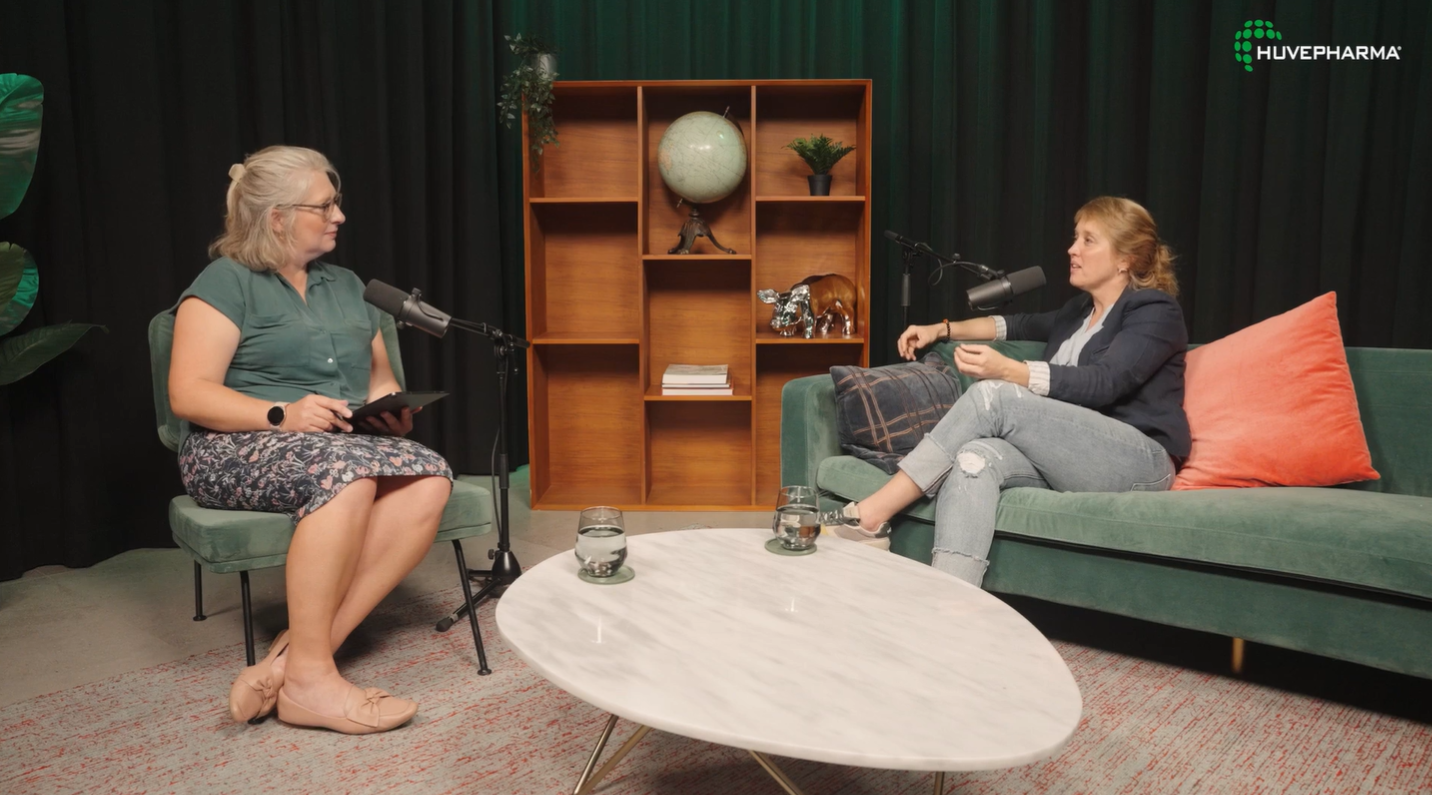
Sjouke Van Poucke is a veterinarian, researcher and entrepreneur with nearly twenty years of experience across academia, the animal health industry and veterinary practice. She obtained her veterinary degree and PhD in Virology at Ghent University.
In 2021, she founded SYN+, an independent consultancy and contract research organisation. Her work combines veterinary expertise, applied research, field trials and data analysis to support practical improvements in livestock production.
What we explore
- Why colostrum intake and maternal protection can differ within the same litter.
- How sow-herd instability and heat stress can affect the piglet's starting position.
- Why neonatal intestinal disease may still matter after apparent recovery.
- The difference between intestinal health and intestinal resilience.
- How declining maternal protection interacts with developing immunity and weaning stress.
- Why pathogen detection must be interpreted alongside clinical findings and farm history.
- How intestinal dysfunction can affect performance without obvious diarrhoea or mortality.
What to remember
Looking health today does not necessarily mean a piglet can cope well with tomorrow's challenge. Resilience describes the capacity to maintain function and recover from disturbance.
Piglets enter weaning with different histories. Those histories interact with separation, mixing, environmental changes and feeding behaviour to shape their subsequent health.
Detecting a microorganism does not, by itself, establish the cause of disease. Timing, clinical signs, lesions, pathogen characteristics and the wider farm context help determine its significance and support responsible treatment decisions.
Put the conversation into practice
When investigating a post-weaning problem, reconstruct the group's history:
- What happened in the sow herd?
- What happened during birth and lactation?
- What changed around weaning?
Connect that history with the onset of signs and the diagnostic findings.
Ask not only "which pathogen did we find?", but also "why did disease develop in these piglets, in this batch, at this particular moment?"
Read the full transcript here
00:00
Sjouke Van Poucke
That's exactly where I think is the challenge. As a vet in the field, finding the pathogen is relatively easy. Finding a trigger, that is really a challenge.
00:16
Caroline Noonan
Welcome to HuveCast. We talk to experts about the real challenges in livestock production and what works in practice. This first season is all about weaning to winning, about getting piglets through that critical transition as smoothly as possible. Today we're asking why some piglets cope with weaning better than others, even when they seem to face exactly the same conditions. Joining me is Sjouke Van Poucke from SYN+. Sjouke, welcome.
00:49
Sjouke Van Poucke
Thank you very much.
00:51
Caroline Noonan
Sjouke, how did you get into pig health? What attracted you to the industry?
00:56
Sjouke Van Poucke
What really triggered me was in pig health, it's, let's say the preventive approach. The fact that you're not looking at an individual animal, but you look at groups of animals in different age categories, where at the end of the day, the industry needs to make his revenue. So, you're not only thinking about diseases, you also think in terms of revenue and economics. And well, given the fact that I actually did a PhD in virology, maybe explains or shows the connection. I like thinking preventively and on group level.
01:30
Caroline Noonan
Okay, so let's start with something that people will recognise. Okay, if you've got two piglets, they both are fed the same thing, they're under the same growth conditions. Why can one piglet have such a different growth performance to another one?
01:47
Sjouke Van Poucke
There's many factors that can play a role there and that can explain it. First of all, genetics. The point is that basically already there the basis can be set for how they are sensitive to pressure of infections. Another aspect obviously is what happens already very shortly after farrowing. We know that let's say the distribution of colostrum and milk. Even if they are within the same litter, coming from the same sow, they certainly do not have the same chances to uptake colostrum and milk. And both of these obviously are very much linked with immunity, what happens further on. But not only immunity, also the development of the microbiome. So even when they're on paper it looks like they are the same pigs, in reality they are not.
02:43
Sjouke Van Poucke
And I think it also explains maybe why we see in the field that even when you repeat the same practices and you think, this time I have it all controlled, next time repeating the same thing does not necessarily give you the same results.
03:02
Caroline Noonan
If you've got a post winning problem, how far back would you look?
03:07
Sjouke Van Poucke
I would say really far back. And basically, already what happens during gestation. Because what we know, and something that we will see fully now in this period, for example, is that if sows go to a hard time in gestation, for example, the heat stress, as we had this summer, that will have a huge impact on the development of the piglets and as such also the quality when they get born and there the start is made. So, if you have a good start, and then again, we look at how easily are they going to have that colostrum uptake, the first day already has a huge impact. So also looking at what is the parity of the sow that they're coming from traditionally, we'll see that these particular problems that we are specifically linking with piglets coming from primiparous secondary parity cells. So, yeah, that's how far you go back.
04:05
Caroline Noonan
Do you remember a case where there was a problem after weaning that originated, like right back? Have you got any examples of that?
04:14
Sjouke Van Poucke
Yeah, there can be several ones. But let's say under our working circumstances here in Belgium, where we still have quite some presence of purse in most of the farms, that can be a typical illustration where you have breakthrough of PRRS infection in the sow herd during that critical phase in the gestation period. And effectively we will see that these types of sows will not produce the colostrum levels that you expect to have, that you need to have. And you can nicely illustrate that we do measure, let's say, the colostrum uptake. Sometimes in farms where we suspect this to be an issue, and at the moment of a PRRS breakthrough, you can actually see that it is impacting the capacity to produce the milk and the colostrum. Yeah.
05:09
Caroline Noonan
Obviously colostrum is a really super important part of the development of the piglet. Just how important is that for the piglet's development?
05:18
Sjouke Van Poucke
It is important, but then again, I would not overestimate it. If we're talking about gut health, I think colostrum PPA is more playing a role. When you look at, let's say, that phase after weaning where the maternal immunity is dropping down and the piglet has to start building its own immunity. So, there we're looking most of the time at antibody levels, while if you're talking about development at gut level, I would say that milk is just as important in the components that it is providing to assure that it gets. They were talking about different aspects, chemokines, growth factors, normal components, galactose and mucin production. So, it depends on what you define as, let's say, development but both of them have their roles to play. I would say.
06:18
Caroline Noonan
You've already mentioned PRRS and the sow herd health and how important that is. So, what actually happens to the piglets when the sow herd is, the health of the sow herd is unstable? What do you look for?
06:31
Sjouke Van Poucke
Well, it can be different things. It can be, let's say, a direct effect on the piglets. And that would be the case for PRRS, for example, where you would also have piglets infected with the virus and as a result of that they don't get born with the same competition, let's say, as piglets that are perfectly healthy. So that is a direct infectious result. It can be also more secondary related, where, for example, in cases of a flu outbreak, it's not the piglet that's going to be directly impacted, it will be the fact that the sow is not feeling well during that period of gestation with consequences then in terms of colostrum production and milk production. So, let's say it's the secondary impact.
07:22
Sjouke Van Poucke
But then also we know that the transfer from sow to piglets is not only about immunity but also the bacteria, the bugs. And traditionally we know that this is more critical in primiparous sows than it would be in multiparous sows, where, let's say the overall balance is more stable at different levels. That means it's about immunity, but it's also the stability of the flora that these cells are carrying and they themselves traditionally cope a little bit better with stressors than having a lot of gilts and young sows in the sow herd. So yeah, that is the way that it's already impacting the quality of your piglets also at weaning.
08:13
Caroline Noonan
And for example, I mean, this year in Europe, I mean, heat stress was super high. What impact did that have on sow herds and the piglet performance as well?
08:25
Sjouke Van Poucke
Well, it impacts all along the way, I would say. So, it's a little bit depending on the phase that the sows were in at the moment where the heat stress was occurring. But we definitely saw at these moments that the piglet quality at birth was lower than what we would expect. That means lower weights to start with. Lower weights implies also that there's more piglets not consuming what they should consume in terms of milk and colostrum. But it also had an impact on the weaning weights. And so, we definitely saw more challenges with piglets that had to be weaned from sows that were during that period of time. Now, what you see is many more abortions. It has an impact also on the follicle development and what happens at the moment of insemination. So really everywhere there was more or less an impact.
09:20
Sjouke Van Poucke
I would say the moment that you're seeing it is not only when there is the heat stress occurring, but also now, obviously also sows were not consuming what they had to consume, for example, in the farrowing houses. And these sows will have by the next insemination the consequences of that. So, it's all along the line, I would say.
09:43
Caroline Noonan
So a piglet that is born and has neonatal diarrhoea, it recovers, it looks healthy, it then goes on further to weaning. Does that initial early disease stay with the piglet right through its lifetime or can you assume that it's going to have its optimal performance level?
10:03
Sjouke Van Poucke
I would not say that the disease stays with the piglet because as you just mentioned, it recovers it and most of the infectious diseases, at some point the piglet is building its immunity and is capable of overcoming it. But we certainly do know that especially at the early days of the pig's life, there's a lot of happening in development, right? The microbiome has to develop also the gut barrier is closing, the diversification is happening. And also, it's the development of the villi, for example, on the enterocytes. And depending on the disease that you're dealing with, we know that for example, certain viral infections such as water, can impact those structures for the rest of their lives. So even though that, let's say at first sight the pig has recovered, the chance that it still will have an impact later on is quite feasible.
11:04
Sjouke Van Poucke
Same thing for when it happens to immunity development, right? Because also in this early phase, tolerance and let's say the way that the pig will react on seeing certain antigens is being defined. And if you have a lot of issues going on at that time point already because of your neonatal diarrhoea, you can expect it to have consequences later on.
11:29
Caroline Noonan
And is this where the difference between gut health and gut resilience comes in then?
11:35
Sjouke Van Poucke
Yeah, I think that's probably how you could define it. I would say your gut health is basically how well is your gut functioning at a certain time point? The resilience probably is more of an indicator telling you how well will the animal be coping with the stressor at any time. And so yes, you need to have all the factors because. Exactly. It's why it's so interesting, this gut health, but it's also so complex, you have so many factors putting all the puzzle pieces, the jigsaw together, that it would definitely have an impact on your resilience later on.
12:15
Caroline Noonan
Okay. So as maternal protection gradually declines, the piglet's own immunity is building up. So, is there a crossover point where it's particularly vulnerable for the piglets?
12:29
Sjouke Van Poucke
Yes, it's what we would describe as the immunity gap. But also, there it's not only about one factor. Right. You have it happening in several stages, and one, I would say is a little bit more abrupt than the other, simply because that moment of weaning, it means that from one point to the other, the piglet is no longer getting that protection from the milk. However, if you look at the aspect of cholesterol immunity, that is a, let's say, quite different process, which traditionally would happen longer after the weaning process. But then again, it's also very disease dependent. Right. Some antibodies will last a very long period of time. Typical illustrations is parvum, for example, where we know that it stays for up to six months.
13:24
Sjouke Van Poucke
And then you have other diseases where it is much abrupter and where it's traditionally around this seven weeks of age, where they have to cope with the diseases without the support, let's say, of their maternal immunity. Indeed.
13:40
Caroline Noonan
And is that timing different for different individual animals or does that happen altogether?
13:46
Sjouke Van Poucke
No, it then comes back to what happens at colostrum level. Right. Because it's quite simple. The higher levels you start with, the longer they are lasting. So it can be that one piglet already loses its protection at the moment of weaning, while a brother or sister that was more lucky at the first intake of colostrum will have a longer protection. So, it is disease dependent, but it's also piglet dependent quite a bit. Yes.
14:18
Caroline Noonan
Okay, so then the actual weaning process itself, a lot going on. You know, there's maternal separation, mixing, transport, change of food, change of environment, mixing with other animals, a lot going on. What does all of that do to the piglet? What's going on?
14:36
Sjouke Van Poucke
I would say no good. But yeah, it's exactly all these factors that you mentioned that I would summarize as stress. Right. As the major factor that plays. And we know that the brain and the gut are communicating to each other bi-directionally. So basically, the fact of weaning the animal having that stress will certainly assure that the feed uptake, at least around that period, is diminished quite a bit. We know that actually, if you want to have balance, if you want to have stability, a continuous feed uptake is very important. And that's exactly what's not happening around that period. Not to mention that apart from how much they are taking up, it's also a shift to the type of, let's say, proteins that they're dealing with because they go from milk like animal protein to plant protein.
15:45
Sjouke Van Poucke
So that's another stressor that's happening in addition to the fact, as you mentioned, they are facing other littermates. If I speak from our own experience, for example, in our sow herd we have two locations, right? And part of the piglets on the sow herd are always staying in that location. And a majority is actually transferred to other nursery units, which is a transport of about half an hour. It's not a long distance. But if we just look at the results of the piglets after weaning, the ones that get the transfer, and the stress of transport compared to the ones that can stay, it's officially the same piglet. But again, in reality we are facing more intestinal problems at startup for those pigs transferred. So, it just illustrates you what stress as such is doing.
16:42
Caroline Noonan
Has your experience throughout your looking at all of this or your studies and working with pigs, has it changed the way you look at post weaning or the weaning process?
16:54
Sjouke Van Poucke
It's. It has. I wouldn't say it's due to my studies as such, but for sure the working environment has changed. Right. We come from maybe a background where the use of antibiotics was less of a restriction than it is today. So, the reality is that maybe some factors that were more management related could be covered up with the use of antibiotics, which today is becoming more and more a restriction. Right. So automatically you're looking much more into all the other factors that are critical in that difficult period of weaning. That means that there's more attention going to climate, you know, how are the pigs arriving? But equally looking at what is the first quality water quality that this piglet picks up the moment it arrives in this nursery unit. And especially at that stage.
18:00
Sjouke Van Poucke
It's from our studies so far quite tricky because you speak under conditions where actually biofilm is flourishing really well. It's nice and warm in your nursery unit. You don't have a lot of water consumption yet, so there is not a whole lot of flow going on. And then mostly your water has been in the lines for a couple of days before these animals enter. I think this is something that probably in the past we didn't look at too much in detail, I must say. Yes, today it's an aspect that we are focusing on more, trying to improve in order to have that process going smoother.
18:41
Caroline Noonan
If you were called to a unit that had post weaning diarrhoea or any sort of disease implications on the farm, what's the first thing that you would look at?
18:51
Sjouke Van Poucke
Climate. And I know that's not maybe the typical answer from a vet because we tend to think in terms of diseases and bacteria and viruses and obviously if you are looking for them in those piglets, you will find them. And that's the tricky part in terms of diagnostics. But the reality is that the mistakes that are made on, you know, the reception of the pigs and the impact that can have, it's definitely the first thing I would like to cross off my list. Actually. Not too long ago, and even in summer, so it was still quite nice, warm. I entered a farm that had received piglets. They were looking awful. Diarrhoea, no foods, all, you know, stacked onto each other and trembling. And the feeling was, it's not too warm in here, is it?
19:50
Sjouke Van Poucke
So when we looked back into the computer, the farmer had simply forgotten to reset his program and officially the piglets were much older than in reality. But also, the speed in which this has the consequences is enormous. Half a day and you can have a completely different piglet in your nursery unit.
20:09
Caroline Noonan
Wow. Okay, what about if you did get a PCR result and found pathogen E. coli, rotavirus, something like this? Is that enough information alone to say what's going on?
20:24
Sjouke Van Poucke
Definitely not. I would say any PCR will give you that result, even in healthy piglets. So that's the tricky point. It's all about a balance. And in the case of the diarrhoea, it's the disbalance that occurs. So, PCR as such, not informative enough. CT value could be a first indicator to say something semi quantitative. But I think when it comes to the diarrhoea, we should not underestimate the value of a good old-fashioned histology.
21:02
Caroline Noonan
Exactly. Yeah. Perfect. That was going to be my next point is, you know, lesions, virology, histology, that will part of the bigger.
21:10
Sjouke Van Poucke
Picture. Exactly. And then you can dive into looking at, let's say prevalence factors because if you're just talking about E. coli. Yeah. Then you will find it in every pig. It needs to have at least some minimal virulence factors in order to be potentially causative.
21:27
Caroline Noonan
So have you ever had any experience where a lab result pointed in one direction? But actually, what was going on in the piglets was something that was a bit different?
21:37
Sjouke Van Poucke
What we do see sometimes is that, you know, again, if it's a recurrent problem, and that's mostly when you would start doing all the diagnostics, right? It's not always pointing towards the same direction to start with. So it might be that in one batch you have really the feeling that the rotavirus playing a major role, you might be focusing on that one. And if you look the next batch, then it seems that there's another factor being more prominent. And I think that just illustrates the fact that it's so multifactorial, not only in terms of external factors, but also in disease causing agents. And that's where it's then sometimes troubling because you try to say, okay, we're going to focus, for example on the salmonella by vaccinating the sow herds. And then the next batch you think, huh, there was something else popping up.
22:37
Sjouke Van Poucke
Now should I change my entire approach or is it an end, end story? And then you come to the point where there is financial limitation because by definition you could be, for example, vaccinated and everything. But the reality is that's also not going to happen. So yeah, that's where sometimes in the context of weaning diarrhoea, it's quite challenging. And there is a factor that we haven't even touched yet when we're talking about food, because let's say that's a little bit blind spots quite often, and I'm not saying it's always the basis obviously, but still a lot of, let's say infectious diseases are the consequences of something that actually has its basis in formulation and nutrition. And then probably it's not the vaccination that we should be looking at, it's the nutritional part, which is not, let's say, my expertise.
23:43
Sjouke Van Poucke
But we certainly, out of experience, you do feel sometimes that, yeah, they change the food formulation or they change the food mill and all of a sudden the problem is solved.
23:56
Caroline Noonan
So severe diarrhoea and mortality are the obvious signs, the external signs, but presumably there's a lot going on in the intestine that we can't see. Is there anything that you can explain there?
24:08
Sjouke Van Poucke
Yeah, there's definitely a lot that you cannot see macroscopically, I would say, or at first sight just looking at the pig. There is also an intermediate phase where you would see that the pig is not really thriving. But at the same point you don't see diarrhoea or you don't have that mortality. And that is something that for me today is just as relevant as the very severe clinical outbreaks. And mostly these pigs will start up well after weaning, just after a week, two weeks, you see that they are not thriving. The hair is a little bit longer; they're not filled as they should be. And obviously then also your technical results will not be in line. Right. In certain cases, when you would open up a piglet like that, you do see that the intestine is actually being reactive, right?
25:06
Sjouke Van Poucke
So there is some inflammation going on, there is an immune response. And we know that immunity is very much steered by what is happening at microbiome level. If you don't have the favourable bacteria, they will be producing neurotransmitters, for example, that impact your brain. They will be producing a lot of cytokines and other reactive, let's say, molecules that are impacting your immune response. And the reality is that the energy that the animal is taking up, the nutrients, they will go to growth, or they go to the immune response. So, whatever goes to immunity is not being used for growth. And that is definitely one of the, let's say, subclinical aspects of having gut health that is not in balance that we are not seeing so easily at first sight.
26:07
Caroline Noonan
If the immune system's being triggered all the time and persistent immune system activation, what does that look like? What does the pig. How does the pig tell you that's happening?
26:17
Sjouke Van Poucke
There goes a lot of, let's say, explosions, I would say, is what you could refer it to. We're talking about cytokine storms. So, it all sounds quite abrupt. And I think that's also what it is. And sometimes you do open up piglets that, you know, after three, four weeks being weaned, you see that there was an immune reaction going on in the intestine. Without being very specific for one bacterium or one virus, it's just reactivity, right? And then you see this red colour, you have this lymph nodes that are inflated, that are swollen, and that's exactly what is going on. Then it's your immunity going in overdrive.
27:05
Caroline Noonan
So how do producers prevent these things happening before they start? Is it even possible to look at prevention?
27:15
Sjouke Van Poucke
It is certainly possible to look at it. The issue is that not everything is a guarantee. We know that, for example, piglets that already had a good food uptake in the farrowing house are more likely to cope with it when they are being weaned. And the fact or the chance that they will keep on eating after weaning is bigger. So there again, we are already looking back before the weaning moment. All these other factors that we discussed, such as water uptake, water quality, climate, these are things that can be controlled by the farmer because we know if they're not checked, it might be the trigger that makes the weaning process very critical. But on the other hand, sometimes you see farmers where you think, I don't see the mistake in this context, I don't find what it is.
28:19
Sjouke Van Poucke
They seem to put everything on the checklist done correctly and still the result in the stable is not what you're expecting for. So I would say 75% of the cases, yes, the farmer can prevent it. 25% maybe. It's a long history of searching what is the trigger in that part. And then you have always these changing factors we talked about; the temperature, the climate, the season that is changing. At the same time genetics are constantly changing. We haven't looked into that in detail. But if we look at the type of terminal boars that we're working with today and fast growing animals, the way that we are weaning a piglet today and the type of feed programs that we apply are far away from what used to be, let's say the standards five years ago, 10 years ago.
29:22
Sjouke Van Poucke
And there I think the field and the knowledge is always coming a little bit later on. You know, first the genetics change and then we need to learn out of experience what is the best adaptation and best formulation. So, it's kind of, let's say, yeah, trial and error process sometimes that we face.
29:42
Caroline Noonan
And then there's also the sort of teamwork aspect of it. So, you've got the farm manager, but you've also got maybe nutritionists involved and veterinarians involved and everybody plays their part, hey, to cover everything.
29:55
Sjouke Van Poucke
That's absolutely true and I think that's certainly something that we can still improve in is to have all those people sitting at the table together and go for one common strategy that everybody is aligned. Now the reality is that you see someone is recommending this and the other one would say no, but have a look at that, I would do it that way. And at some point, you know, I think the farmer gets lost in translation as to say maybe he does some cherry picking what is most convenient for him and most likely something that he doesn't have to change but someone else it's easier to picked. So there. I totally agree with your comment. It's team sports.
30:39
Caroline Noonan
If a vet arrives on a farm and is investigating some post weaning disease on a farm, what are the top three things that you would recommend that they look at?
30:52
Sjouke Van Poucke
First of all, I would look at where is it occurring? I mean, is it in one compartment? Is it an overall problem? And quite often, let's say that the type of diarrhoea that you see can already gives you an indicator. So just use your eyes, I would say, is the first observation. Look at the basics. So, basics are consumption of water, consumption of food, and what is the environment that they are in. And only if you have, let's say, checked off these aspects, then you can start thinking about what samples would I be collecting to look into infectious aspects. But it's never my number one.
31:37
Caroline Noonan
And what is the one question that you think they should always ask before concluding that it's a pathogen involved in some disease?
31:46
Sjouke Van Poucke
I would say that actually there is always going to be a pathogen involved because at the end of the day, that's why you have the diarrhoea. The real question is it only an infectious agent and is that the trigger, or is there something else way before it? And that's exactly where I think is the challenge. As a vet in the field, finding the pathogen is relatively easy. Finding a trigger, that is really a challenge sometimes, and certainly because you do not have all the information always from the customer there. I would say if you really want to know what happens, you should be there at the meeting day, which obviously cannot be done, but it's very often the most informative moment to find your information.
32:51
Caroline Noonan
Super. I think we're coming up to the conclusion of our discussions, which have been super useful, so thank you so much. So, to summarise, if there's one practical thing that I can take from this, and hopefully our listeners can take from this episode, I'm. What I'm hearing is that it's that you should. Yeah. Go back to basics, look at everything, look at the climate, use your eyes, look at the piglets, and look at what they're telling you. Of course you're going to find a pathogen, but there's so much more to the situation than just finding that pathogen. You need to understand what the trigger is, why it's important, what's happening in these piglets at this moment. And look at the bigger picture, which might also include going back into the history of the sow herd. Is there anything else?
33:43
Sjouke Van Poucke
Absolutely. With you? Yeah. Okay.
33:46
Caroline Noonan
Good.
33:47
Sjouke Van Poucke
And it's exactly why you asked me before the podcast, why do I want to be a veterinarian in pig industry? And that's exactly coming back to that. It's the complexity. It's the fact that there's so many factors before the event that already have an impact and that you need to keep looking at the larger picture and preventively most of the time. So yeah, that's more or less it.
34:12
Caroline Noonan
Thank you so much for your time, Sjouke. It's been an absolute pleasure to speak with you.
34:16
Sjouke Van Poucke
Likewise, thank you.
34:18
Caroline Noonan
Want to learn more about why some piglets are more vulnerable than others around weaning? You'll find more information on HuveCast. And make sure to explore the full series for more practical insights on weaning. Thanks for listening to HuveCast.
Further reading
Devillers, N., Le Dividich, J. and Prunier, A. (2011). Influence of colostrum intake on piglet survival and immunity. Animal. 5(10). 1605-1612. https://doi.org/10.1017/S175173111100067X.
Han, X., Hu, X., Jin, W. and Liu, G. (2024). Dietary nutrition, intestinal microbiota dysbiosis and post-weaning diarrhea in piglets. Animal Nutrition, 17. 188-207. https://doi.org/10.1016/j.aninu.2023.12.010
Iribagiza, A., Nimbona, C., Hanyurwumutima, E., Mvuyekure, E., Hakizimana, E., Nzeyimana, M.C. and Irakoze, S. (2025). Post-Weaning Diarrhea in Piglets: Causes, Risk Factors, and Management Strategies. Open Journal of Animal Sciences, 15(04). 369-381. https://doi.org/10.4236/ojas.2025.154026
Liao, S.F., Ji, F., Fan, P. and Denryter, K. (2024). Swine Gastrointestinal Microbiota and the Effects of Dietary Amino Acids on Its Composition and Metabolism. International Journal of Molecular Sciences, 25(2). 1237. https://doi.org/10.3390/ijms25021237
Moeser, A.J., Pohl, C.S. and Rajput, M. (2017). Weaning stress and gastrointestinal barrier development: implications for lifelong gut health in pigs. Animal Nutrition, 3(4). 313-321. https://doi.org/10.1016/j.aninu.2017.06.003
Rahman, R., Marcolla, C. and Willing, B.P. (2025). Fecal microbiota transplantation in pigs: current status and future perspective. Animal Microbiome, 7(1). https://doi.org/10.1186/s42523-025-00440-w
Rhouma, M., Fairbrother, J.M., Beaudry, F. and Letellier, A. (2017). Post weaning diarrhea in pigs: risk factors and non-colistin-based control strategies. Acta Veterinaria Scandinavica, 59(1). 31. https://link.springer.com/article/10.1186/s13028-017-0299-7
Ruampatana, J., Suwimonteerabutr, J., Homyog, K., Mekboonsonglarp, W., Kanjanavaikoon, K., Van der Veken, W., Poonyachoti, S., Feyera, T., Settachaimongkon, S. and Nuntapaitoon, M. (2024). Clostridium butyricum Probiotic Feed Additive: Modulation of Sow Milk Metabolomics and Mitigation of Pre-Weaning Piglet Diarrhea. Animals, 14(14). https://doi.org/10.3390/ani14142098
