

The disease is caused by protozoan parasites of the Eimeria type which, even in modern production systems, still require proper control.
In addition, coccidiosis is also one of the main triggers of other gastrointestinal disorders such as necrotic enteritis and dysbacteriosis, further highlighting the importance of proper control.
In broiler chickens, coccidiosis control is achieved primarily through the preventative inclusion of anticoccidial compounds in the feed.
Vaccination is another option: most European coccidiosis vaccines contain attenuated "early" lines of Eimeria, meaning they have reduced reproductive potential without reducing immunogenic potential.
The HuveGuard® MMAT vaccine contains four attenuated strains of Eimeria (E. maxima, E. mitis, E. acervulina, and E. tenella), carefully selected to achieve a sufficiently high reproductive potential to achieve a high immunogenic potential.
HuveGuard® MMAT
As a result, vaccination with HuveGuard® MMAT generates a high excretion of oocysts, while ensuring a low level of lesions. To minimise the impact that this type of vaccination has on the gastrointestinal tract, supportive products are often applied along with these types of vaccines.
A good example of such a product is B-Act®, a probiotic additive containing viable spores of a unique and exclusive strain of Bacillus licheniformis (DSM 28710).
Probiotics are viable microorganisms that, when administered in adequate amounts, confer health benefits to the host. Their mode of action can be multifactorial, but it is generally related to protecting the animal's intestinal health, balancing the gut microbiota, and/or supporting the proper functioning of the digestive tract.
The multiplication of Eimeria strains after vaccination, which is necessary to induce immunity, will challenge the birds' immune system and gut health. Therefore, supplementing with a probiotic during vaccination makes sense, and B-Act® is the perfect tool for doing so.
The specific probiotic strain is not only registered for use in multiple poultry species in Europe, but the logic of supplementing with a probiotic during vaccination was recently confirmed under research conditions.
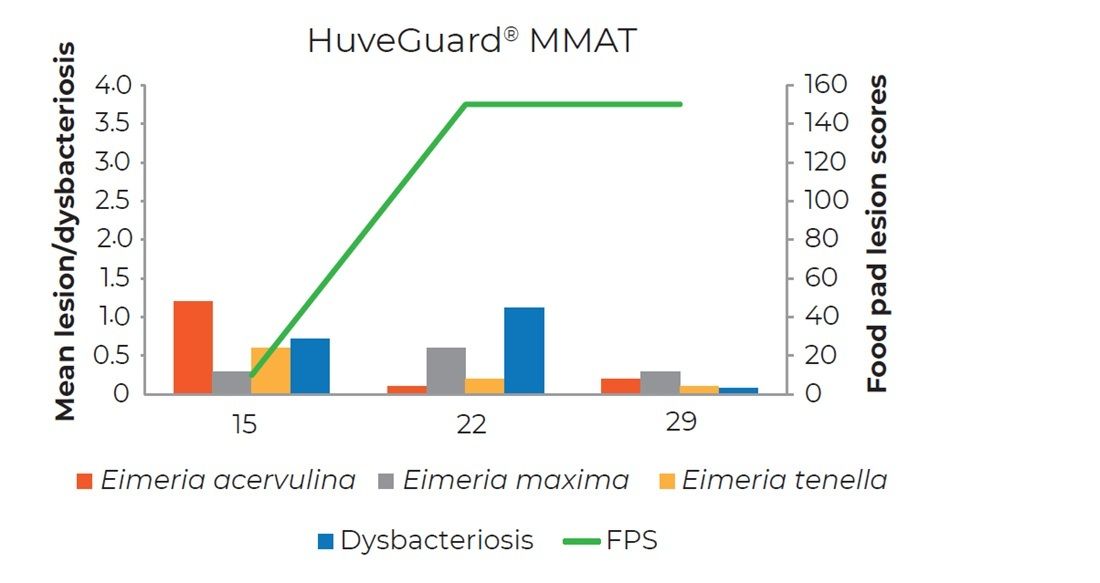
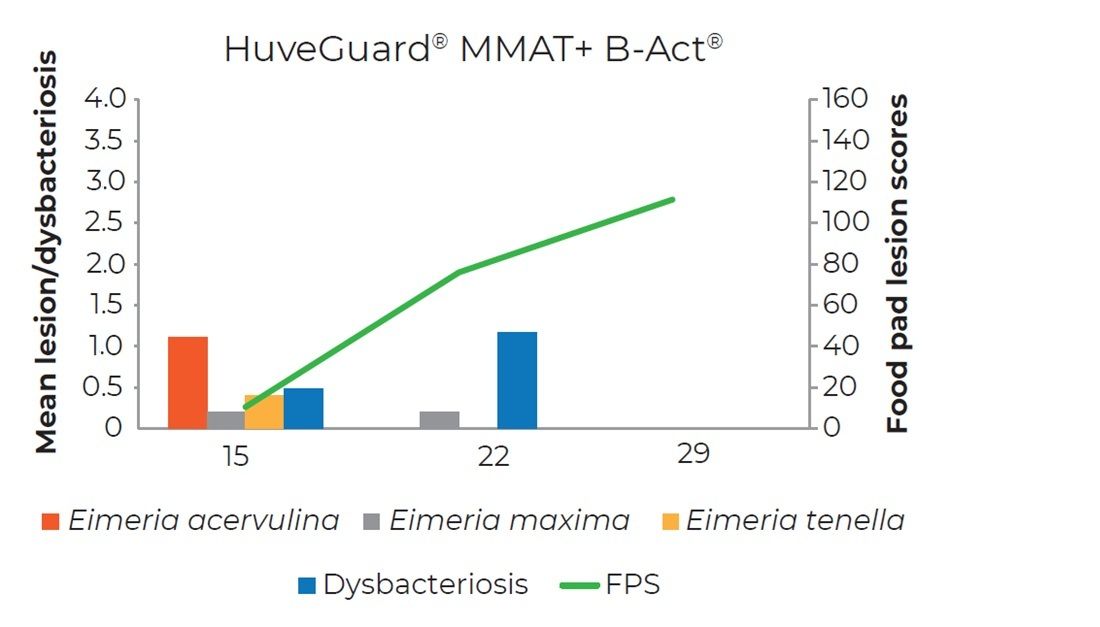
A study was conducted in pens with 110 male Ross broilers to investigate the impact of vaccination with HuveGuard® MMAT alone or in combination with B-Act®.
The HuveGuard® vaccine was administered via eye drops to ensure that all birds were vaccinated with the correct dose, while B-Act® was incorporated into the feed (0.5 kg B-Act®/ton of feed).
The combination of HuveGuard® with B-Act® resulted in a reduction of the feed conversion ratio by 0.14 points, while Eimeria lesions were less on days 22 and 29 after vaccination when the animals had received B-Act®.
At the same time, dysbiosis scores and plantar lesions were also lower in the B-Act® groups. Therefore, the beneficial impact of B-Act® on intestinal health and productive parameters of the animals during coccidiosis vaccination was clear.
According to the results of this research, similar results were also observed when commercial farms were monitored, with lower scores of Eimeria lesions and dysbacteriosis observed during summer vaccinations against coccidiosis in Spain.
The three vaccines registered in the EU were used and the results were similar: when the vaccine was combined with B-Act®, lower scores for coccidiosis and dysbacteriosis were observed from 3 weeks of age.
In addition to the above, B-Act® is also known for its inhibitory effect on Clostridium perfringens and therefore plays an important role in the prevention of necrotic enteritis (NE). C. perfringens is an opportunistic pathogen and requires predisposing factors to thrive.
These include, but are not limited to, an imbalance in the gastrointestinal microbiota, injuries to the gastrointestinal tract, and a compromised immune system. By mitigating these factors through probiotic supplementation such as B-Act®, C. perfringens can be controlled, and therefore any associated enteritis can be prevented.
Recent in vitro work has shown that B-Act® inhibits C. perfringens strains associated with NE. This is consistent with the reviewed in vivo research, which confirmed the controlling effect of B-Act® on C. perfringens-induced NE in broilers.
In summary, when using coccidial vaccines, intestinal health should be supported with the help of the probiotic B-Act®, as confirmed under both experimental and field conditions.
By doing so, optimal zootechnical performance is ensured, the risk of NE is minimised, and the animal develops immunity against coccidiosis in the most efficient way possible.


