

Evaluation of 'shuttle' programs under natural challenge conditions
Coccidiosis remains one of the diseases with the greatest economic impact on the global poultry industry.
Despite decades of advancements in nutrition, genetics, facilities, and health management, controlling coccidiosis remains a critical factor in achieving optimal performance and profitability in broiler production. The disease not only causes direct intestinal damage but also negatively impacts feed efficiency, weight gain, flock uniformity, and overall economic results.
While the poultry industry continues to seek effective strategies to control coccidiosis without compromising bird performance, the choice of appropriate coccidiostat programs remains an important decision.
Shuttle programs, which involve changing anticoccidial compounds during the production cycle, are widely used to improve efficacy and help minimise the development of resistance.
A recent study conducted in the Netherlands analysed the impact of two commonly used anticoccidial programs on the performance of broiler chickens under conditions designed to simulate natural exposure to coccidia.
The results provide valuable information on how different combinations of ionophores can influence production efficiency and economic outcomes.
Study objective
The main objective of the trial was to determine the effect of two different coccidiosis control programs on key performance indicators in floor-reared broiler chickens exposed to natural coccidiosis infection.
The researchers compared a monensin/nicarbazin-based program followed by salinomycin, with a narasin/nicarbazin-based program followed by narasin.
Special attention was paid to the evolution of body weight, daily weight gain, feed conversion ratio, mortality, productive efficiency and economic results.
Experimental design
The study was conducted in 2025 using 288 male Ross 308 broilers. The birds were housed on the floor in pens and managed under standard commercial production conditions for 35 days.
To reflect practical field conditions, the birds received a three-phase feeding program:
- Starter - day 0 to day 14
- Grower - day 14 to day 28
- Finisher - day 28 to day 35
On day 14, a natural coccidiosis challenge was introduced by adding litter collected from a commercial broiler farm. This approach allowed researchers to evaluate the program's outcome under conditions more similar to those of commercial poultry farms, rather than relying on artificial challenges.
Two treatment groups were established (Table 1).

The main difference between the programs lay in the change of ionophore in Group A, in which the birds received monensin during the starter phase and salinomycin during the grower and finisher phases.
In contracts, Group B continued to receive narasin throughout the entire production cycle following the initial combination of narasin and nicarbazin.
Measured parameters
Throughout the study, several economic and production indicators were monitored, including:
- Live weight on days 0, 14, 28 and 35
- Food consumption during each feeding phase
- Daily mortality
- Daily weight gain (DWG)
- Feed conversion ratio (FCR)
- European production efficiency factor (EPEF)
- Economic margin per bird
The outcome data were statistically analysed using a two-sample t-test, with the pen as the experimental unit. Statistical significance was set at p < 0.05, while mortality data were assessed descriptively.
Mortality results
One of the first observations of the study was the similarity in mortality rates between the two treatment groups.
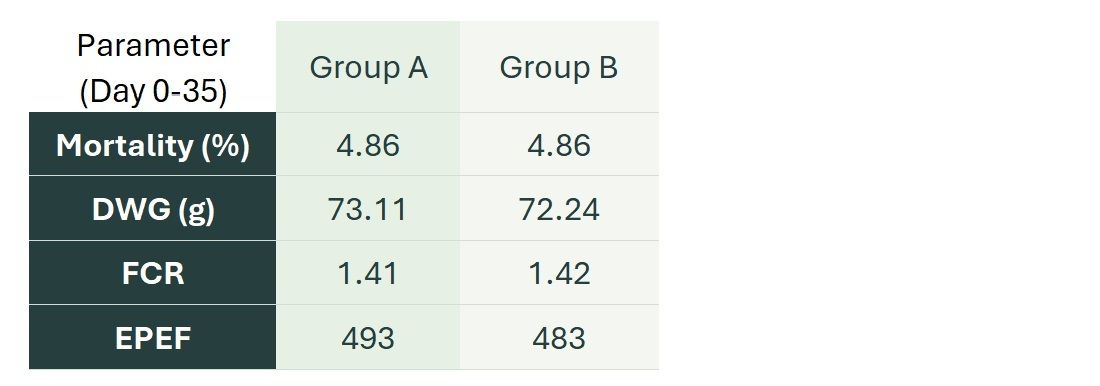
Both programs achieved an identical mortality rate of 4.86%, indicating that neither strategy negatively affected the birds' survival during the trial period.
This demonstrates that the observed differences in productive performance cannot be attributed to effects related to mortality.
In contrast, improvements in growth and feed efficiency can be directly linked to differences in coccidiosis control programs.
Growth results
Body weight development followed a similar pattern in both treatment groups during the early stages of production. The chicks' initial weights were virtually identical, confirming a level playing field for comparison.
Although the differences during the initiation and growth phases were relatively small, a clearer advantage emerged at the end of the production cycle (Table 2).
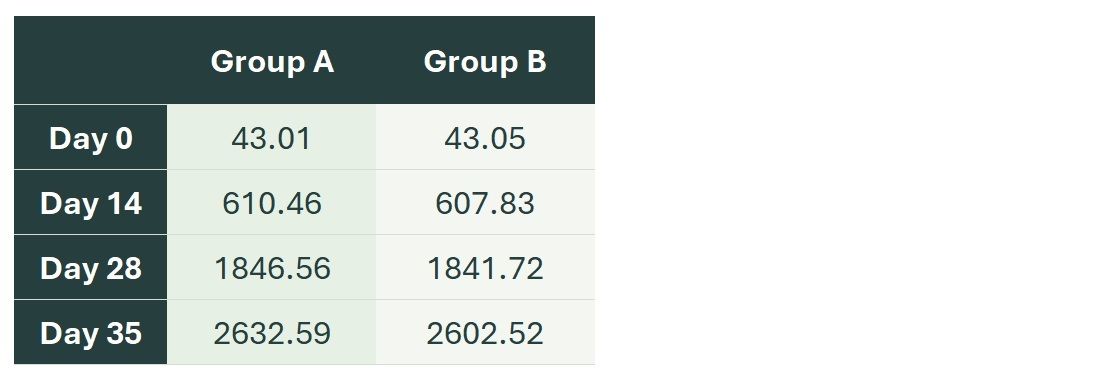
The birds that received the Monimax®/Sacox® program reached a final body weight approximately 30 grams higher than those that received the Maxiban®/Monteban® program.
Daily weight gain
Daily weight gain is a critical indicator of broiler chicken performance, as it reflects both nutrient utilisation and overall health status.
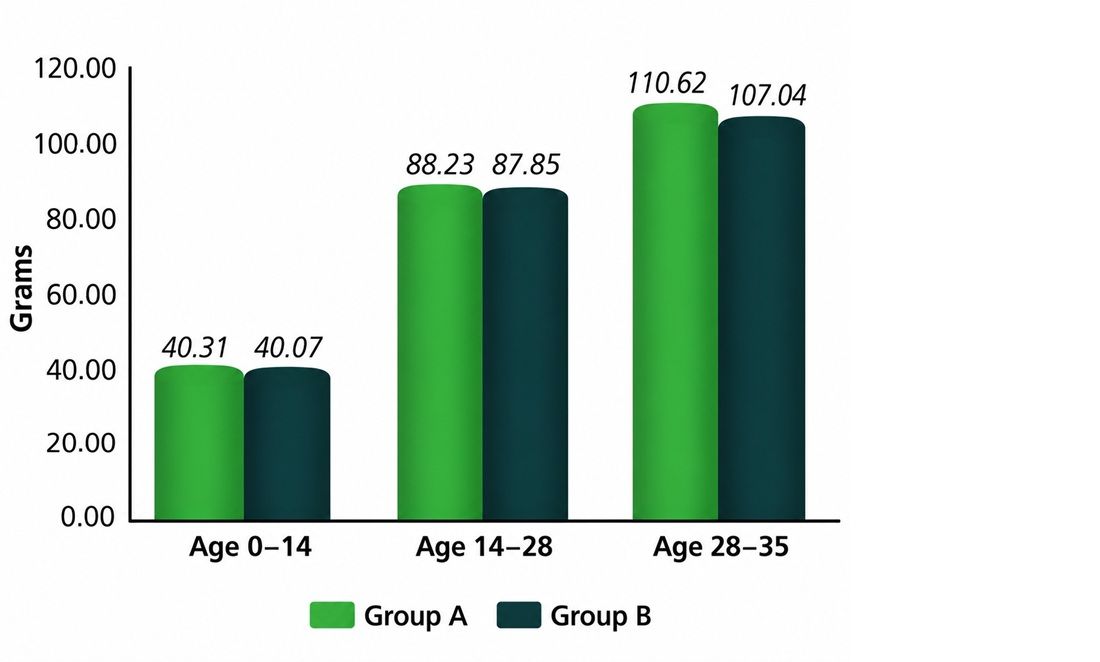
The study revealed that Group A achieved a greater overall daily weight gain compared to Group B (Figure 1).
The improvement in growth results suggests that the Monimax®/Sacox® program promoted better gut health and greater nutrient absorption during the later stages of production.
Since coccidiosis primarily affects the intestinal tract, effective control strategies often translate directly into improved weight gain and overall productivity.
Feed conversion rate
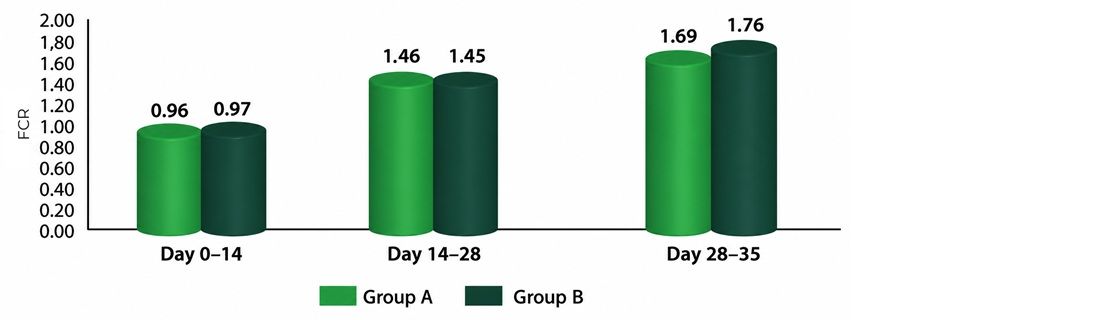
FCR remains one of the most important economic indicators in broiler chicken production as feed represents the largest production cost.
The comparison revealed notable differences between the two programs, particularly during the finishing phase, where the difference in feed conversion reached 0.07 points in favour of Group A.
Total FCR (day 0-35)
The EPEF combines body weight, feed conversion, mortality and age into a single performance measure commonly used throughout the poultry industry.
The results showed a clear advantage for Group A (493) compared to Group B (483). The 10-point improvement in EPEF demonstrates that the benefits observed in growth rate and feed conversion translated into superior overall productive efficiency.
Economic analysis
While the zootechnical result is important, commercial poultry producers ultimately focus on profitability.
To assess the financial implications of each program, the researchers calculated the economic margin per bird by subtracting the costs of the day-old chick and feed from the slaughterhouse revenue.
Why did the Monimax®/Sacox® program achieve better results?
One of the most interesting findings of the study is the performance advantage.
During the starter and grower phases, the differences between the two groups were relatively limited. However, the gap widened considerably during the finisher phase.
This observation suggests that the ionophore change implemented in Group A may have played an important role in maintaining coccidiosis control throughout the production cycle.
Rotating between monensin and salinomycin exposes coccidia populations to different ionophores, reducing selection pressure and improving the overall effectiveness of the program.
Conversely, maintaining narasin during the grower and finisher phases may offer fewer opportunities to alter the parasite's adaptation.
The findings support the widely accepted principle in the industry that rotation programs incorporating strategic ionophore changes can help optimise performance while contributing to sustainable coccidiosis management.
Conclusion
The Dutch study demonstrated a consistent advantage in results with the Monimax®/Sacox® program compared to the Maxiban®/Monteban® program, under natural coccidiosis challenge conditions.
Birds that received monensin/nicarbazin followed by salinomycin achieved greater daily weight gain, better feed conversion, a higher EPEF index and greater economic benefits, while maintaining mortality rates equivalent to those observed in the narasin-based program.
Perhaps most noteworthy is that the performance advantage became more evident during the finisher phase, suggesting that the strategic switch from monensin to salinomycin contributed to better coccidiosis control and greater production efficiency.
For poultry farmers looking to optimise flock performance and profitability, these findings reinforce the value of carefully designed 'shuttle' rotation programs and highlight the potential benefits of incorporating ionophore rotation into commercial coccidiosis control strategies.


